

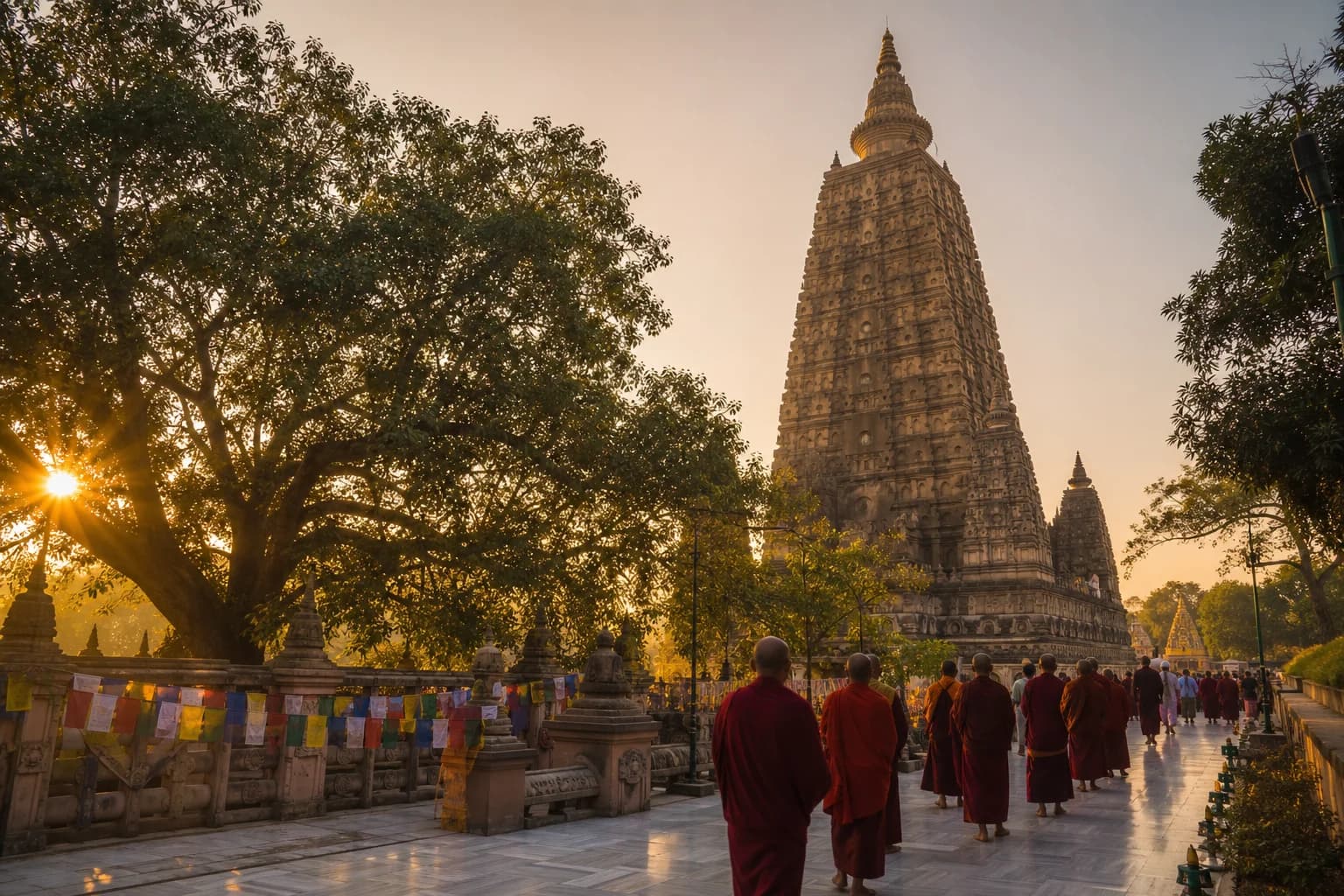
Bodh Gaya — Seat of Enlightenment
The tree beneath which Siddhartha became the Buddha — a quiet Bihari town that is the spiritual centre of gravity for half a billion Buddhists worldwide.
What Makes This Place Distinctive
Twenty-six centuries ago, a wandering prince sat beneath a peepal tree on the banks of the Niranjana river and rose as the Buddha. The Mahabodhi Temple that marks the spot — a UNESCO World Heritage Site — draws monks, nuns and seekers from Sri Lanka to Japan, whose national monasteries ring the town in a living atlas of Buddhist architecture. Bodh Gaya remains what it has always been: a place people cross the world to sit still in.
Historic & Cultural Heritage
The Mahabodhi Temple, first raised by Emperor Ashoka in the 3rd century BCE and rebuilt through the ages, is among the oldest brick temples standing in India and the most sacred site in the Buddhist world.
Arts, Traditions & Everyday Life
Multinational monastic life gives the town an extraordinary layered culture — Tibetan prayer wheels, Theravada chanting, Zen gardens and Bihari village life all within a few unhurried lanes.
Who Shapes This Destination
Resident monks and nuns from across Asia, Bihari farming families, Gaya's hereditary priests and a growing community of meditation teachers and translators share the town.
Traditional Crafts & Makers
Stone carving descended from Magadhan traditions, thangka painting in the Tibetan monasteries, and Bihar's own Madhubani and sujani textile crafts in surrounding districts.
Local Foodways & Markets
Monastery kitchens serving pan-Asian Buddhist vegetarian fare alongside Bihari staples — litti-chokha, sattu drinks and the rice-milk kheer that echoes Sujata's legendary offering.
The Physical & Ecological Context
The flat Gangetic plain of southern Bihar, the seasonal Niranjana river and the rocky Barabar and Brahmayoni hills that framed the Buddha's wanderings.
Practices That Continue Today
Circumambulation of the Mahabodhi stupa, the winter teaching season when the town fills with maroon robes, and meditation retreats continue traditions begun in the Buddha's own lifetime.
How This Place Is Changing
Bodh Gaya balances its role as a global pilgrimage hub with the realities of one of India's poorest regions, making community-benefit tourism especially vital here.
What a Visit Involves
- Meditation beneath the Bodhi tree at the Mahabodhi Temple
- Dawn chanting circuits with monks from a dozen nations
- The international monasteries — Thai, Japanese, Bhutanese, Tibetan
- Sujata Kheer village and the Niranjana river walk
The Challenges
Deep local poverty beside a global pilgrimage economy
Seasonal overcrowding during the winter teaching months
Ensuring pilgrimage spending reaches surrounding villages
Where Can the Destination Grow?
Village-linked experiences connecting pilgrims to local livelihoods
Meditation and study programmes hosted by established monasteries
Heritage interpretation of the wider Magadh Buddhist circuit
These represent potential and opportunity where appropriate — not a guarantee that every visit produces these outcomes.
“Bodh Gaya is the source-spring of a philosophy that reshaped Asia — and a reminder that India's spiritual heritage belongs to the whole world, carried outward for millennia.”
Understanding This Place Comes First.
Uddharsha uses destination understanding as the foundation for how tourism here is designed — with care for culture, communities, heritage and environment.
Explore Responsible & Regenerative TourismUnderstand the Place. Then Experience It.
Explore this destination through its people, heritage, culture and living traditions.