

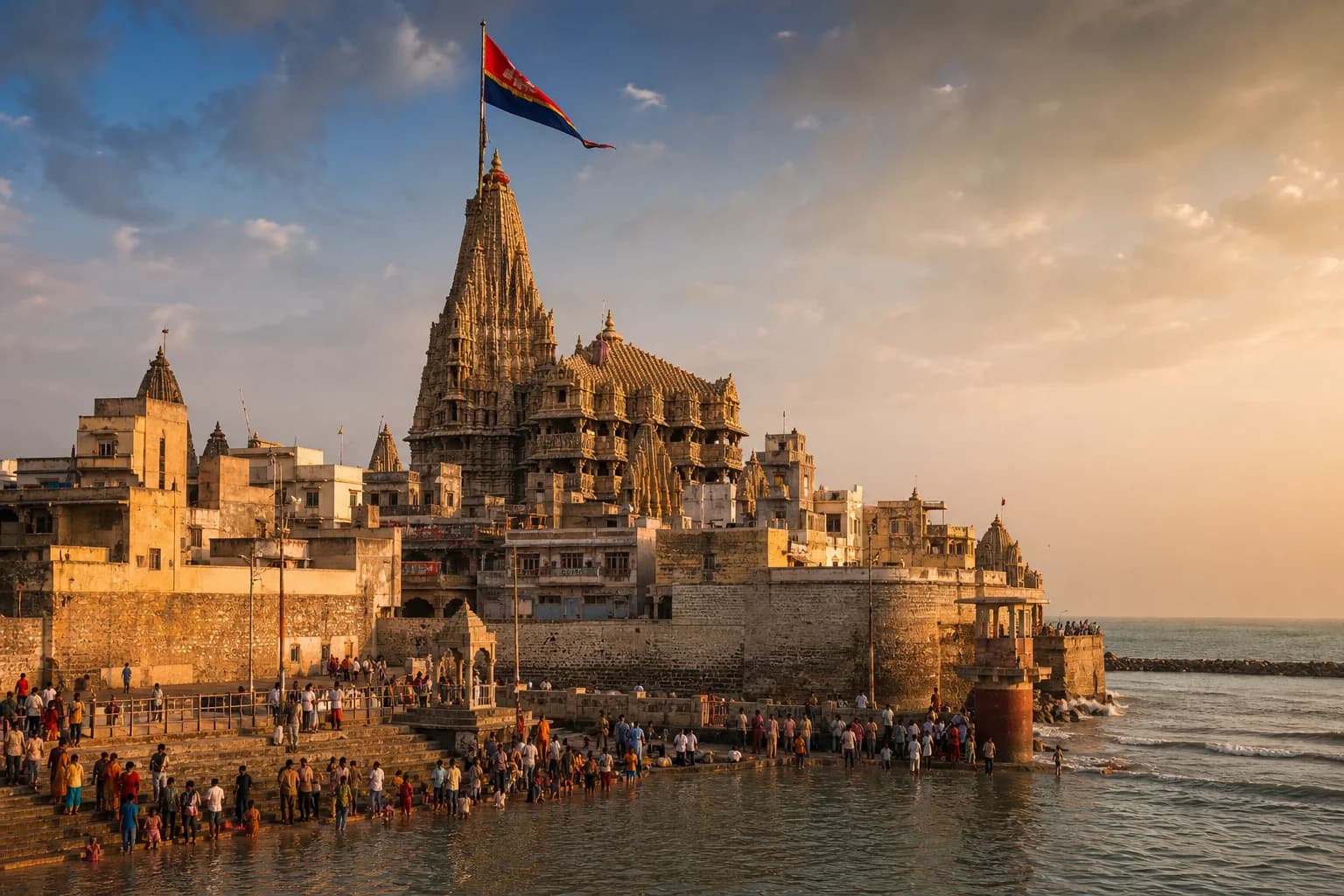
Dwarka — Krishna's Kingdom by the Sea
The westernmost of the Char Dham, where Krishna's legendary sea-city meets the Arabian Ocean and a giant temple flag turns five times a day.
What Makes This Place Distinctive
At the far western tip of the Saurashtra peninsula, Dwarka is remembered as the golden capital Krishna raised from the sea — and to which, the epics say, the sea returned. The five-storeyed Dwarkadhish temple rises above the Gomti creek where river meets ocean, its enormous flag changed ceremonially five times daily. Marine archaeology offshore has found submerged structures that keep the legend tantalisingly alive, while nearby Bet Dwarka island and the Nageshwar Jyotirlinga complete one of Hinduism's four cardinal pilgrimages.
Historic & Cultural Heritage
One of the four Char Dham and one of the seven ancient Moksha-puris, Dwarka layers epic memory, a 2,500-year temple tradition and offshore archaeological remains of a submerged historic port city.
Arts, Traditions & Everyday Life
Krishna bhakti saturates daily life — dhun singing on the ghats, Janmashtami celebrations that swell the town tenfold and the maritime devotional culture of Gujarat's temple coast.
Who Shapes This Destination
Gugali Brahmin temple priests, Kharva fishing communities, boatmen ferrying pilgrims to Bet Dwarka and Saurashtra herder-farmer families sustain the pilgrimage town.
Traditional Crafts & Makers
Bandhani tie-dye from the Jamnagar belt, shell and coral-substitute craft, temple flag stitching — each massive dhwaja hand-sewn — and Saurashtra's embroidery traditions.
Local Foodways & Markets
Saurashtrian vegetarian fare — thepla, khichdi-kadhi, dabeli and shrikhand — served in pilgrim bhojanalayas, with Janmashtami's makhan-mishri echoing Krishna's butter lore.
The Physical & Ecological Context
A low, wind-scoured coastline of creeks, salt flats and open Arabian Sea horizons, with dolphin-rich waters around Bet Dwarka's sandy island shores.
Practices That Continue Today
The five daily flag ceremonies, Gomti bathing rituals, the boat pilgrimage to Bet Dwarka and Janmashtami's midnight birth celebrations continue undimmed.
How This Place Is Changing
New coastal infrastructure and the Sudarshan Setu bridge are transforming pilgrim access, while marine conservation and fishing livelihoods negotiate the changing shore.
What a Visit Involves
- Darshan at the five-storeyed Dwarkadhish temple
- The ceremonial flag-changing seen from the Gomti ghats
- Boat crossing to Bet Dwarka island shrines
- Nageshwar Jyotirlinga and sunset at the Gomti-sea sangam
The Challenges
Coastal erosion and cyclone exposure on the temple shore
Peak-festival crowding in a small peninsular town
Balancing new infrastructure with sacred-town character
Where Can the Destination Grow?
Maritime heritage interpretation including the submerged-city story
Dolphin and coastal ecology experiences with fishing communities
Bandhani and temple-craft trails through the Jamnagar belt
These represent potential and opportunity where appropriate — not a guarantee that every visit produces these outcomes.
“Dwarka holds the meeting point of myth, ocean and archaeology — a city civilisation remembers losing to the sea, still worshipped at the water's edge.”
Understanding This Place Comes First.
Uddharsha uses destination understanding as the foundation for how tourism here is designed — with care for culture, communities, heritage and environment.
Explore Responsible & Regenerative TourismUnderstand the Place. Then Experience It.
Explore this destination through its people, heritage, culture and living traditions.