

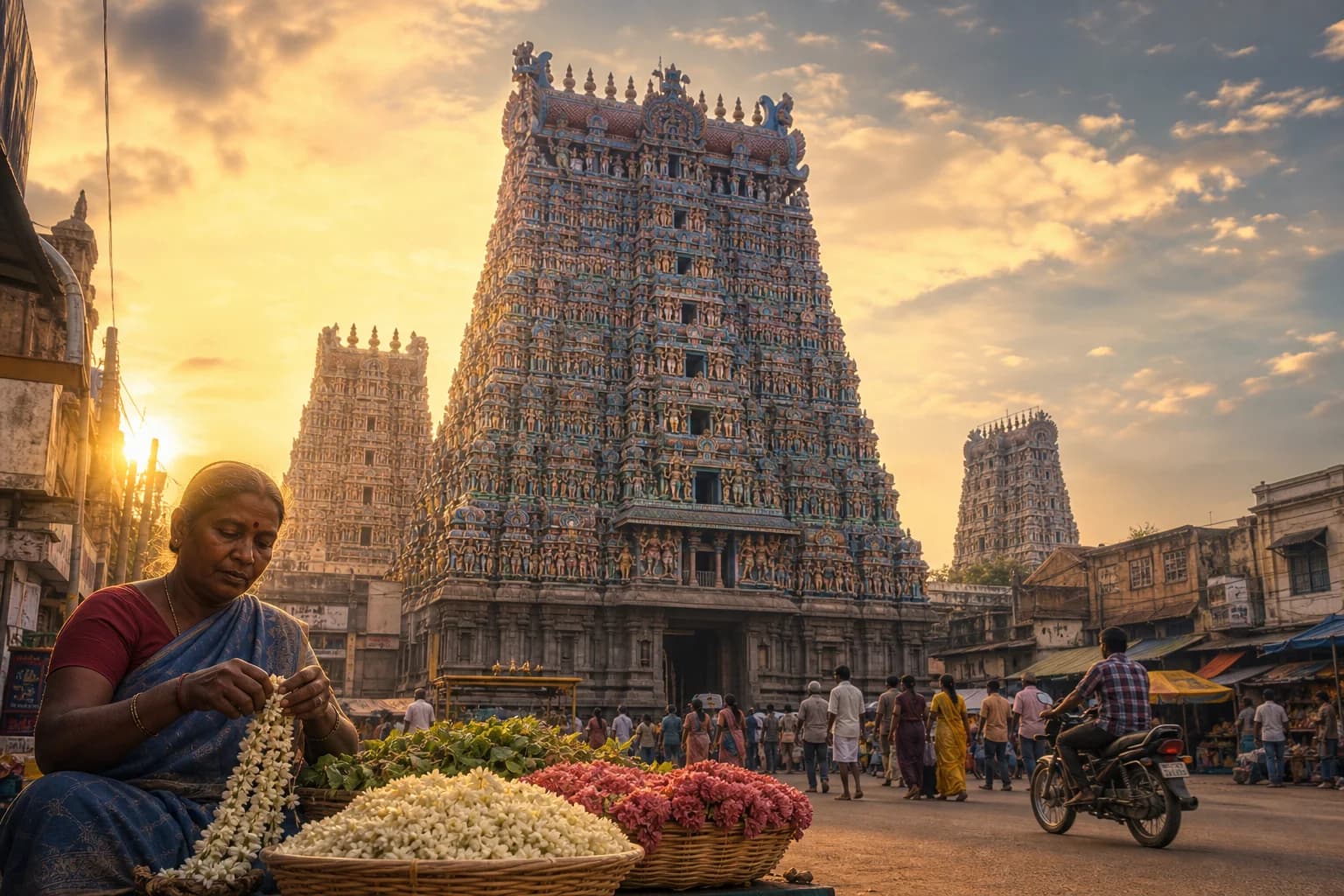
Madurai — City of the Goddess
One of the world's oldest continuously inhabited cities, arranged like a lotus around the Meenakshi temple — where the goddess rules and the city still keeps her hours.
What Makes This Place Distinctive
Madurai has been a city for well over two thousand years, praised by Greek ambassadors and Sangam poets alike. At its heart stands the Meenakshi Amman temple, its fourteen technicolour gopurams crowded with tens of thousands of sculpted gods, and its nightly ceremony in which Shiva is carried to the goddess's chamber so the divine couple may rest together. The old city's concentric streets follow the temple's ancient mandala plan — urban design as devotion.
Historic & Cultural Heritage
A Sangam-era capital of the Pandya kings and a centre of Tamil literary academies, Madurai's temple-centred city plan, Nayak palace and living epigraphy make it an open-air chronicle of Tamil civilisation.
Arts, Traditions & Everyday Life
Goddess-centred devotion, the Chithirai festival's celestial wedding drawing a million celebrants, Tamil scholarship and a street culture famous for staying awake past midnight — 'the city that never sleeps' long before the phrase travelled.
Who Shapes This Destination
Temple priests and elephant keepers, jasmine growers and garland weavers, tank-street traders and the hereditary sculptor and musician families of the temple economy.
Traditional Crafts & Makers
Madurai sungudi tie-dye cotton (GI-tagged), bronze and stone sculpture lineages, garland artistry and the famed jasmine cultivation that perfumes the city's mornings.
Local Foodways & Markets
Madurai's legendary street table — jigarthanda coolers, kari dosai, bun parotta and the pre-dawn kitchens serving temple-town workers before first light.
The Physical & Ecological Context
The Vaigai river plain of southern Tamil Nadu, ringed by rocky Pandya-country hills and the jasmine and paddy farmland that feeds the city's markets.
Practices That Continue Today
The nightly palliyarai procession, the Chithirai festival's river crossing, daily garland offerings and the unbroken recitation traditions of the temple continue as the city's clock.
How This Place Is Changing
Madurai balances booming pilgrimage and heritage tourism with old-city congestion, while its crafts and jasmine trade find new global markets.
What a Visit Involves
- The Meenakshi temple's fourteen sculpted gopurams and golden lotus tank
- The night ceremony carrying Sundareswarar to Meenakshi's shrine
- Dawn flower market and the jasmine trade of Madurai malli
- Thirumalai Nayakkar palace and evening sound-and-light heritage
The Challenges
Old-city congestion and heritage-fabric strain around the temple
Fair returns for jasmine growers and garland workers
Conserving gopuram sculpture amid weather and pollution
Where Can the Destination Grow?
Dawn-to-midnight cultural walks through the temple economy
Sungudi textile and jasmine-farm experiences with growers
Festival-season programmes interpreting the Chithirai traditions
These represent potential and opportunity where appropriate — not a guarantee that every visit produces these outcomes.
“Madurai is proof that a city can be built as an act of worship and remain one — its streets, trades and nights still ordered by the goddess at its centre.”
Understanding This Place Comes First.
Uddharsha uses destination understanding as the foundation for how tourism here is designed — with care for culture, communities, heritage and environment.
Explore Responsible & Regenerative TourismUnderstand the Place. Then Experience It.
Explore this destination through its people, heritage, culture and living traditions.