

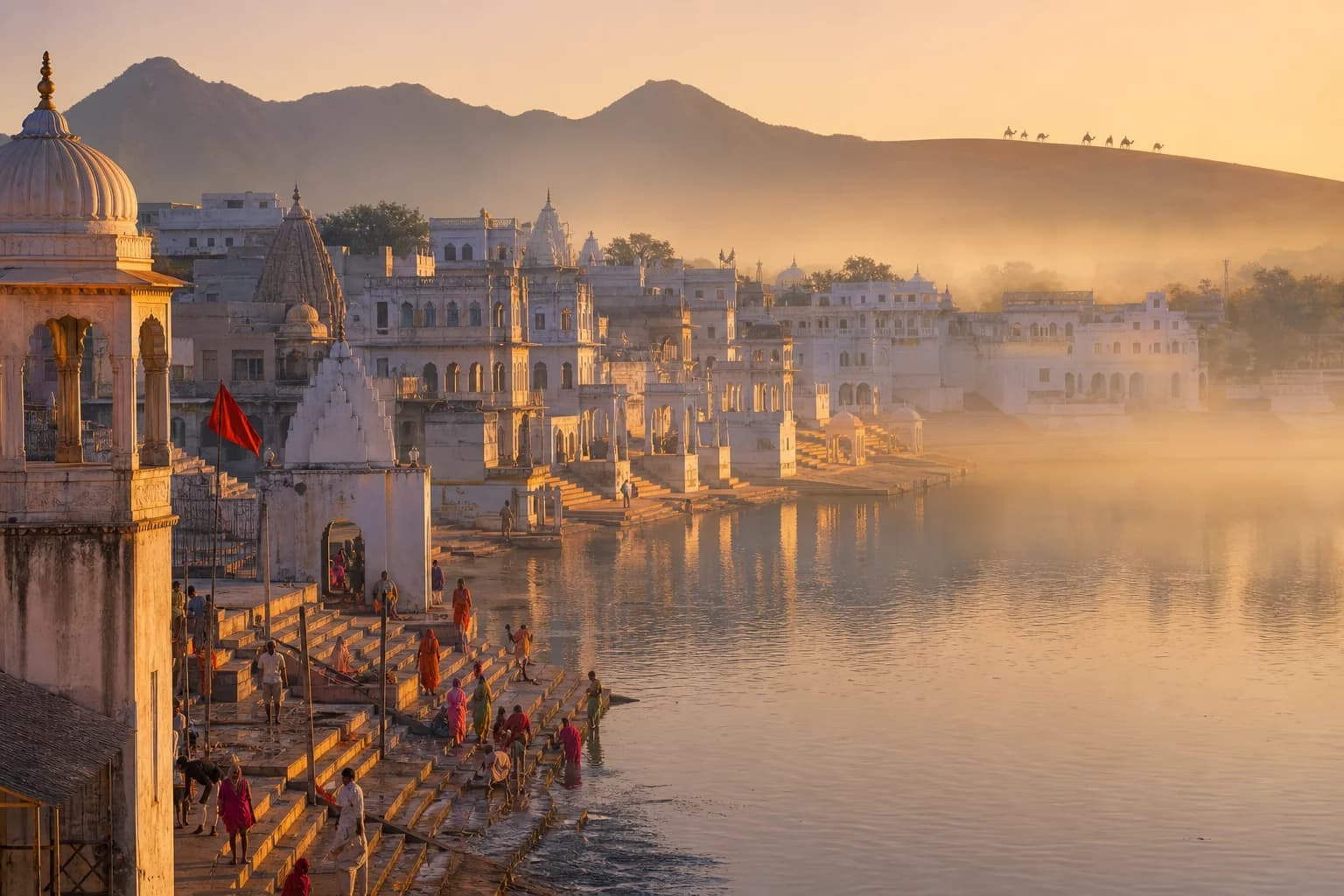
Pushkar & Ajmer — Lake of Brahma, Court of the Saint
A holy lake ringed by five hundred temples and, across a single desert ridge, the Sufi shrine where emperors walked barefoot — two faiths breathing side by side.
What Makes This Place Distinctive
Few places compress India's spiritual plurality like this pair of towns separated by one Aravalli pass. Pushkar's sacred lake — said to have sprung from a lotus dropped by Brahma himself — holds one of the world's only major Brahma temples and fifty-two bathing ghats. Eleven kilometres away, Ajmer Sharif, the dargah of the Sufi saint Moinuddin Chishti, has drawn Hindu, Muslim and Sikh pilgrims alike for eight centuries. Together they are a masterclass in shared sacred geography.
Historic & Cultural Heritage
Pushkar appears in the Mahabharata as an ancient tirtha, while Ajmer's dargah — patronised by Mughal emperors who walked the final stretch on foot — anchors South Asia's most important Sufi lineage.
Arts, Traditions & Everyday Life
Ghat rituals, sacred bathing and camel-herding pastoral culture in Pushkar meet the qawwali music, langar traditions and rose-offering devotion of Ajmer's Sufi court.
Who Shapes This Destination
Pushkar's hereditary ghat priests and Rebari camel herders, Ajmer's khadims (shrine custodians), qawwals, rose farmers and pilgrim traders form two intertwined sacred economies.
Traditional Crafts & Makers
Rose attar distilling, block-printed textiles and camel-leather craft, mojari shoemaking and the garland and votive crafts serving both shrine towns.
Local Foodways & Markets
Malpua from Pushkar's ghat-side griddles and pure-vegetarian pilgrimage fare on one side; Ajmer's kadai milk, biryani traditions and dargah langar on the other.
The Physical & Ecological Context
A desert-edge lake cupped in the Aravalli hills, the Snake Mountain ridge between the towns, and dune country stretching west toward the Thar.
Practices That Continue Today
Lake worship, the Kartik Purnima bathing festival and camel fair, the daily lighting of the dargah lamps and the Urs festival keep both towns in continuous ritual motion.
How This Place Is Changing
Backpacker cafés and wedding tourism press against Pushkar's sacred codes, while both towns work to manage huge festival influxes with dignity and care.
What a Visit Involves
- Sunrise mist over Pushkar lake and its fifty-two ghats
- The rare Brahma temple and evening lake aarti
- Qawwali at Ajmer Sharif dargah after the evening prayers
- The Pushkar camel fair's devotional and pastoral spectacle
The Challenges
Lake water quality and shrinking catchment in a drying region
Tourism behaviour clashing with ghat and shrine etiquette
Fair benefit-sharing for pastoral and shrine-service communities
Where Can the Destination Grow?
Interfaith heritage walks across the two sacred towns
Rose-farm and attar-distillery experiences with Ajmer growers
Ethical camel-culture programmes with Rebari herding families
These represent potential and opportunity where appropriate — not a guarantee that every visit produces these outcomes.
“Pushkar and Ajmer prove that India's sacred landscape is plural at its very core — a lake of Brahma and a Sufi court sharing pilgrims, seasons and a single desert horizon.”
Understanding This Place Comes First.
Uddharsha uses destination understanding as the foundation for how tourism here is designed — with care for culture, communities, heritage and environment.
Explore Responsible & Regenerative TourismUnderstand the Place. Then Experience It.
Explore this destination through its people, heritage, culture and living traditions.