

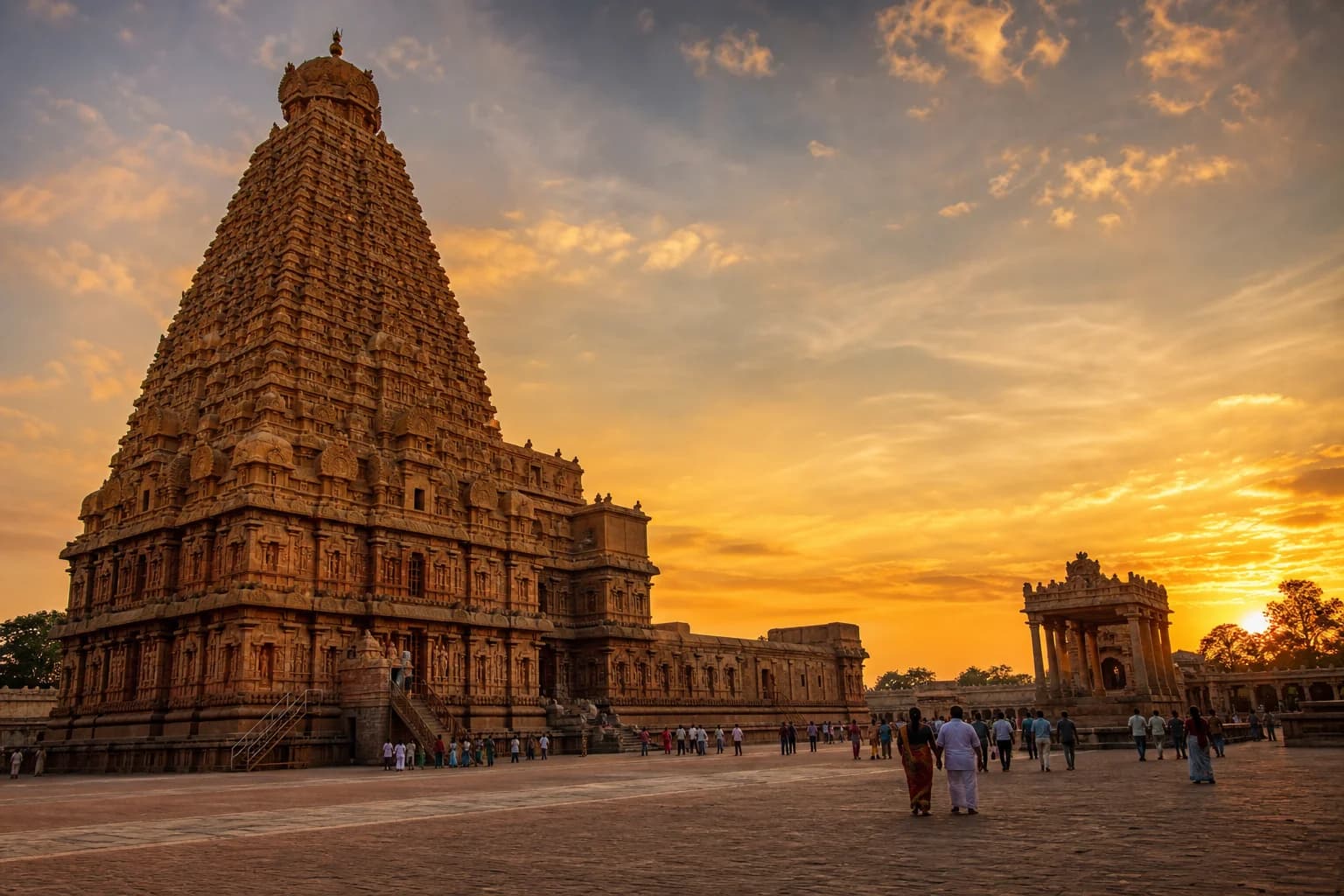
Thanjavur — Granary of the Cholas
Where the Brihadeeswara temple's granite tower rises over a city that gave India its Chola bronzes, Tanjore paintings and a living classical music tradition.
What Makes This Place Distinctive
Thanjavur was the capital of the Chola empire at its height, and its Brihadeeswara temple — a thousand years old — remains one of the greatest achievements of Indian architecture. Around it, the crafts the Cholas patronised continue: lost-wax bronze casting in nearby Swamimalai, gold-leaf Tanjore painting, and the veena-making and Carnatic music culture of the Kaveri delta.
Historic & Cultural Heritage
The Great Living Chola Temples — Brihadeeswara chief among them — represent the summit of Dravidian architecture, alongside a palace, library and mural heritage spanning Chola, Nayak and Maratha rule.
Arts, Traditions & Everyday Life
Thanjavur is a heartland of Carnatic music, Bharatanatyam's temple origins and the sadir-to-stage story, with temple festivals still ordering the delta's cultural calendar.
Who Shapes This Destination
Sthapathis (hereditary bronze casters), Tanjore painters, veena makers, temple priests and delta farming families carry the region's interlinked traditions.
Traditional Crafts & Makers
Chola-descended lost-wax bronze casting, gold-foil Tanjore painting, veena crafting from jackwood, and bell-metal and pith work of the Kaveri delta.
Local Foodways & Markets
Kaveri delta vegetarian cooking — sambar, kootu and temple prasadam traditions — alongside the famous Thanjavur degree coffee culture.
The Physical & Ecological Context
The flat, green rice bowl of the Kaveri delta, its horizon punctuated by temple gopurams and the great vimana of Brihadeeswara.
Practices That Continue Today
Bronze icons are still cast for temples by hereditary sthapathis exactly as prescribed in the shilpa shastras, and daily worship continues in the thousand-year-old temple.
How This Place Is Changing
GI-tagged Thanjavur painting and Swamimalai bronze work reach global collectors, while cultural tourism grows around the Chola temple circuit.
What a Visit Involves
- Brihadeeswara Temple at sunrise — a UNESCO World Heritage Site
- Bronze-casting workshops in Swamimalai using the lost-wax method
- Tanjore painting and veena-making studios
- Saraswathi Mahal Library and the Maratha palace complex
The Challenges
Sustaining hereditary craft lineages against cheaper imitations
Conservation of murals and monuments in active worship
Fair market access for traditional sthapathi workshops
Where Can the Destination Grow?
Workshop visits with hereditary bronze-casting families
Music and dance heritage programming in the delta
Support for GI-authenticated Tanjore art
These represent potential and opportunity where appropriate — not a guarantee that every visit produces these outcomes.
“Thanjavur shows how imperial patronage created craft lineages that survive a millennium later — living proof that heritage is a continuing practice, not a ruin.”
Understanding This Place Comes First.
Uddharsha uses destination understanding as the foundation for how tourism here is designed — with care for culture, communities, heritage and environment.
Explore Responsible & Regenerative TourismUnderstand the Place. Then Experience It.
Explore this destination through its people, heritage, culture and living traditions.