

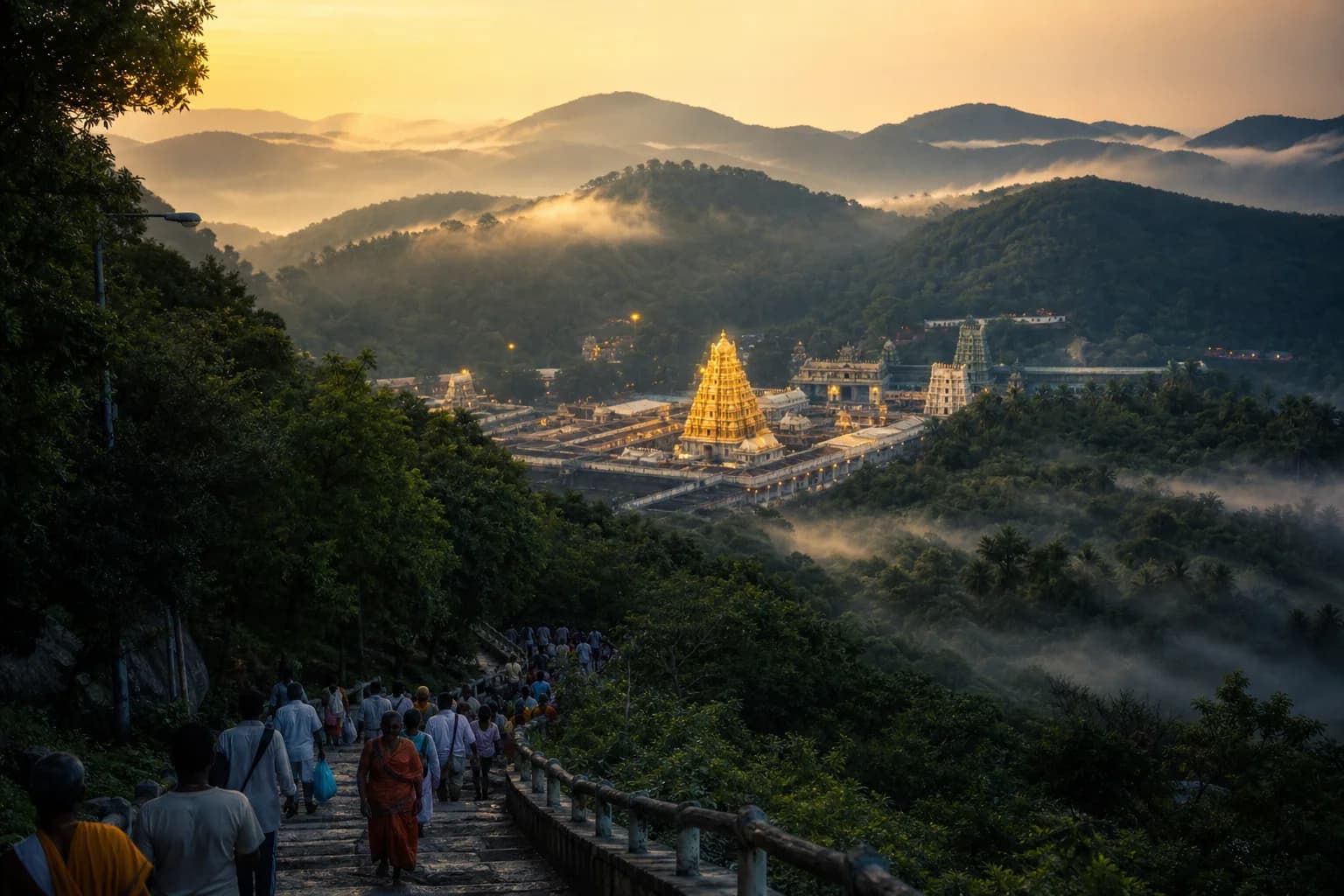
Tirupati & Tirumala — Hill of the Seven Peaks
The most visited sacred site on earth — where Lord Venkateswara waits atop seven forested hills and devotion is offered in footsteps, tonsures and laddus.
What Makes This Place Distinctive
Rising from the Seshachalam forests of southern Andhra Pradesh, the seven hills of Tirumala carry a temple that receives more pilgrims than any other shrine in the world. Devotees climb thousands of steps barefoot, offer their hair in tonsure halls that never close, and queue through the night for a few seconds before the jewel-covered form of Venkateswara. Around this extraordinary devotional engine, the temple trust runs schools, hospitals and forest conservation — a complete sacred economy in motion.
Historic & Cultural Heritage
The Tirumala temple's recorded history spans over a millennium of Pallava, Chola and Vijayanagara patronage — Krishnadevaraya's gifts are inscribed on its walls — making it a living archive of South Indian temple statecraft.
Arts, Traditions & Everyday Life
Sri Vaishnava ritual in unbroken continuity, Annamacharya's 32,000 devotional songs composed for this deity, and a pan-Indian pilgrim culture where every language of the country stands in one queue.
Who Shapes This Destination
Hereditary archakas, barbers of the tonsure halls, laddu makers producing hundreds of thousands of sweets daily, forest-dwelling Yanadi communities and millions of pilgrims form Tirumala's human tide.
Traditional Crafts & Makers
Kalamkari painting from nearby Srikalahasti, wooden Tirupati gangireddu dolls and red-sanders carving traditions, alongside garland-making on a scale unmatched anywhere.
Local Foodways & Markets
The GI-tagged Tirupati laddu, vast free annadanam halls feeding lakhs daily, and Rayalaseema's fiery vegetarian table in the town below the hills.
The Physical & Ecological Context
Seven forested hills of the Seshachalam range — a UNESCO-recognised biosphere of red-sanders forests, waterfalls and ancient footpaths rising from the southern plains.
Practices That Continue Today
The unbroken daily ritual calendar, hair-offering vows, the annual Brahmotsavam processions and pada-yatra climbing traditions continue at extraordinary scale.
How This Place Is Changing
The temple trust's model of channelling offerings into education, healthcare and conservation makes Tirumala a case study in how sacred institutions can serve society.
What a Visit Involves
- The Alipiri footpath climb — 3,550 steps of pilgrim devotion
- Darshan of Sri Venkateswara in the golden-vimana sanctum
- The tonsure halls and the famous Tirupati laddu prasadam
- Sri Venkateswara National Park's red-sanders forests and waterfalls
The Challenges
Managing the world's largest pilgrim volumes with dignity
Red-sanders smuggling pressure on the Seshachalam forests
Ensuring the pilgrim economy benefits local communities fairly
Where Can the Destination Grow?
Footpath pilgrimages interpreting forest and devotional heritage together
Srikalahasti Kalamkari craft extensions to the temple circuit
Biosphere conservation awareness woven into the pilgrim journey
These represent potential and opportunity where appropriate — not a guarantee that every visit produces these outcomes.
“Tirumala demonstrates devotion at civilisational scale — logistics, forest, art and faith fused into a single mountain institution serving millions with remarkable order.”
Understanding This Place Comes First.
Uddharsha uses destination understanding as the foundation for how tourism here is designed — with care for culture, communities, heritage and environment.
Explore Responsible & Regenerative TourismUnderstand the Place. Then Experience It.
Explore this destination through its people, heritage, culture and living traditions.