

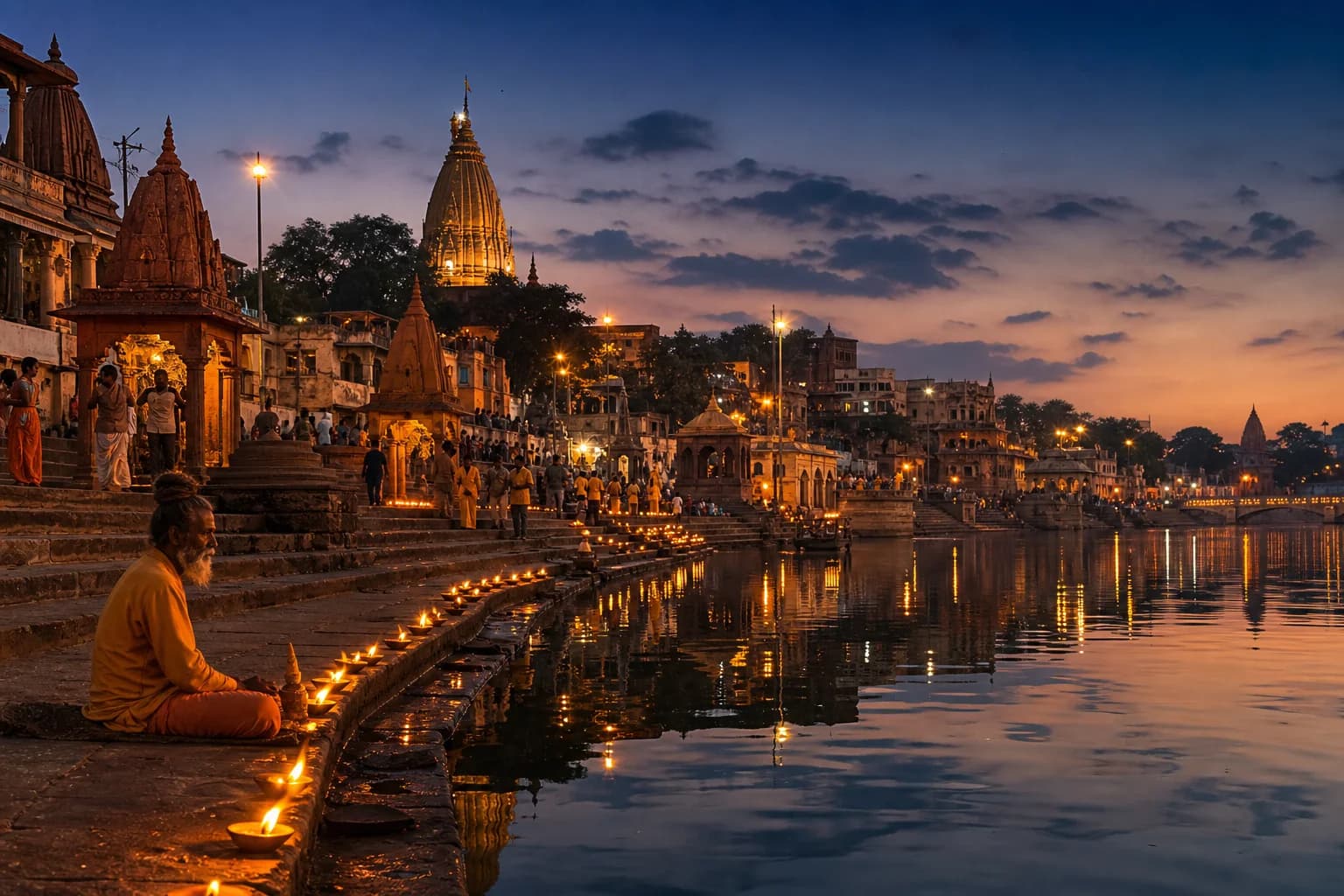
Ujjain — City of Mahakal
One of India's seven sacred cities, where Shiva reigns as Mahakal — the Lord of Time — and the Shipra's ghats host the great Simhastha Kumbh.
What Makes This Place Distinctive
Ujjain has been sacred for as long as Indian memory runs — capital of ancient Avanti, home of the poet Kalidasa, seat of the Mahakaleshwar Jyotirlinga and the city from which Indian astronomers once measured the prime meridian. Its pre-dawn bhasma aarti, in which the deity is adorned with sacred ash, is among the most electrifying rituals in Hinduism, and every twelve years the Simhastha Kumbh turns the Shipra's banks into one of the largest gatherings on earth.
Historic & Cultural Heritage
Ujjain layers Mauryan, Gupta and Maratha history over one of the twelve Jyotirlingas; its observatory tradition — from ancient meridian calculations to Jai Singh's 18th-century Vedh Shala — makes it a city of both faith and science.
Arts, Traditions & Everyday Life
Shaiva ritual life, Sanskrit scholarship in Kalidasa's own city, wrestling akharas and the great cycle of Kumbh gatherings define Ujjain's cultural temperament.
Who Shapes This Destination
Temple priests, akhara sadhus, astrologers and panchang-makers, boatmen of the Shipra and Malwa farming families animate the sacred city.
Traditional Crafts & Makers
Batik and Bagh-influenced textile printing of the Malwa region, brass ritual-ware casting, and the making of rudraksha rosaries and ceremonial regalia for the temple economy.
Local Foodways & Markets
Malwa's generous vegetarian table — poha-jalebi mornings, dal-bafla, sabudana khichdi on fast days and thick rabri at century-old sweet shops near the temple.
The Physical & Ecological Context
The gentle Malwa plateau, black-soil farmland and the slow Shipra river curving past stone ghats and temple spires.
Practices That Continue Today
The bhasma aarti performed daily for centuries, savari processions of Mahakal through the old city each monsoon, and the twelve-yearly Simhastha Kumbh remain fully alive.
How This Place Is Changing
The vast new Mahakal Lok corridor has transformed pilgrim capacity and city pride, while raising fresh questions about heritage character and the Shipra's water health.
What a Visit Involves
- The pre-dawn bhasma aarti at Mahakaleshwar Jyotirlinga
- Evening lamps and chanting at Ram Ghat on the Shipra
- The Vedh Shala observatory and Ujjain's astronomical heritage
- Kal Bhairav, Harsiddhi and the city's tantric temple circuit
The Challenges
Shipra river pollution and seasonal water stress
Balancing mega-corridor development with old-city heritage
Managing extreme crowd surges during festivals and Kumbh years
Where Can the Destination Grow?
Heritage walks linking the observatory, poetry and temple traditions
River-restoration awareness woven into pilgrimage experiences
Malwa craft and food trails extending visits beyond the shrine
These represent potential and opportunity where appropriate — not a guarantee that every visit produces these outcomes.
“Ujjain embodies India's oldest idea of sacred time — a city where astronomy, poetry and devotion have measured the cosmos together for over two thousand years.”
Understanding This Place Comes First.
Uddharsha uses destination understanding as the foundation for how tourism here is designed — with care for culture, communities, heritage and environment.
Explore Responsible & Regenerative TourismUnderstand the Place. Then Experience It.
Explore this destination through its people, heritage, culture and living traditions.