

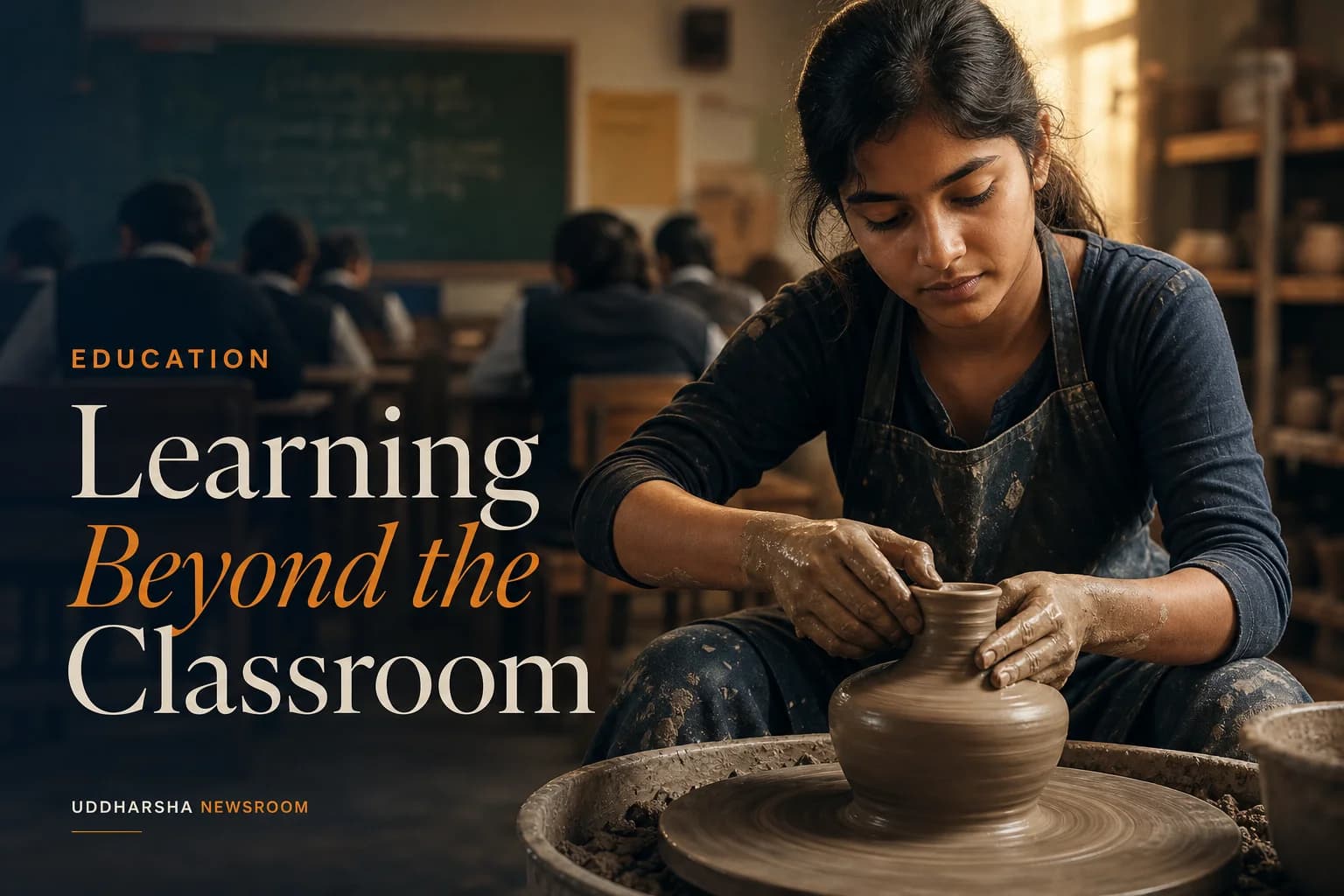
India's National Education Policy put experiential learning at the centre of how schools are asked to teach. Educators are discovering what practitioners have long known: some things can only be learned in the field.
Ask any adult what they remember from school and the answers are rarely a page of a textbook. They are the field trip, the science fair, the play they staged, the place they visited that made a chapter suddenly real. Education research has long confirmed the intuition: knowledge anchored in direct experience is understood more deeply and retained far longer.
India's National Education Policy 2020 turned that insight into national direction, explicitly calling for experiential learning — hands-on activity, arts-integrated and sports-integrated education, story-telling-based pedagogy — as a standard part of how classrooms work. The policy's ambition is a generation that learns how to think and apply, not merely recall.
For schools, the hardest question is not whether to embrace this, but how. A visit that is merely a day out produces photographs, not learning. The difference lies in structure: preparation before the journey, guided observation and reflection during it, and synthesis afterwards — journals, presentations, projects that make the learning visible.
This is where the worlds of education and culture meet. A craft cluster is a live lesson in material science, economics and design. A heritage town is a walkable archive of history, urban planning and faith. A conversation with a farmer, a weaver or a conservationist teaches more about interdependence than any diagram. India's cultural landscape is, in effect, the country's largest classroom — most of it still unused.
The institutions moving first are discovering a second benefit: immersive journeys build precisely the capacities employers and universities now ask about — teamwork, communication, comfort with unfamiliar contexts, empathy across social difference. These are not extracurricular garnish; they are the curriculum of adult life.
The direction of travel is clear. The classroom is not being replaced — it is being extended, into workshops, fields, festivals and communities. The educators who learn to design for that extension will define what Indian schooling looks like in the coming decade.
Source & Verification
Editorial analysis by the Uddharsha Editorial Desk, drawing on publicly available reports, registers and data acknowledged below.
- Original Source
- Reference — National Education Policy 2020, Ministry of Education
Credits & Acknowledgements
- Written and edited by Uddharsha Editorial Desk, Uddharsha Foundation Newsroom.
Transparency note: sections presented as the Uddharsha Perspective reflect the Foundation's editorial analysis and interpretation. All other reported facts, figures and materials originate from the sources acknowledged above.
Select a topic to discover related coverage across the Uddharsha Newsroom.
Uddharsha Editorial Desk
News • Features • Perspectives
The Uddharsha Editorial Desk reports, documents and interprets developments across India's culture, heritage, tourism, education, arts, communities and wider public life.