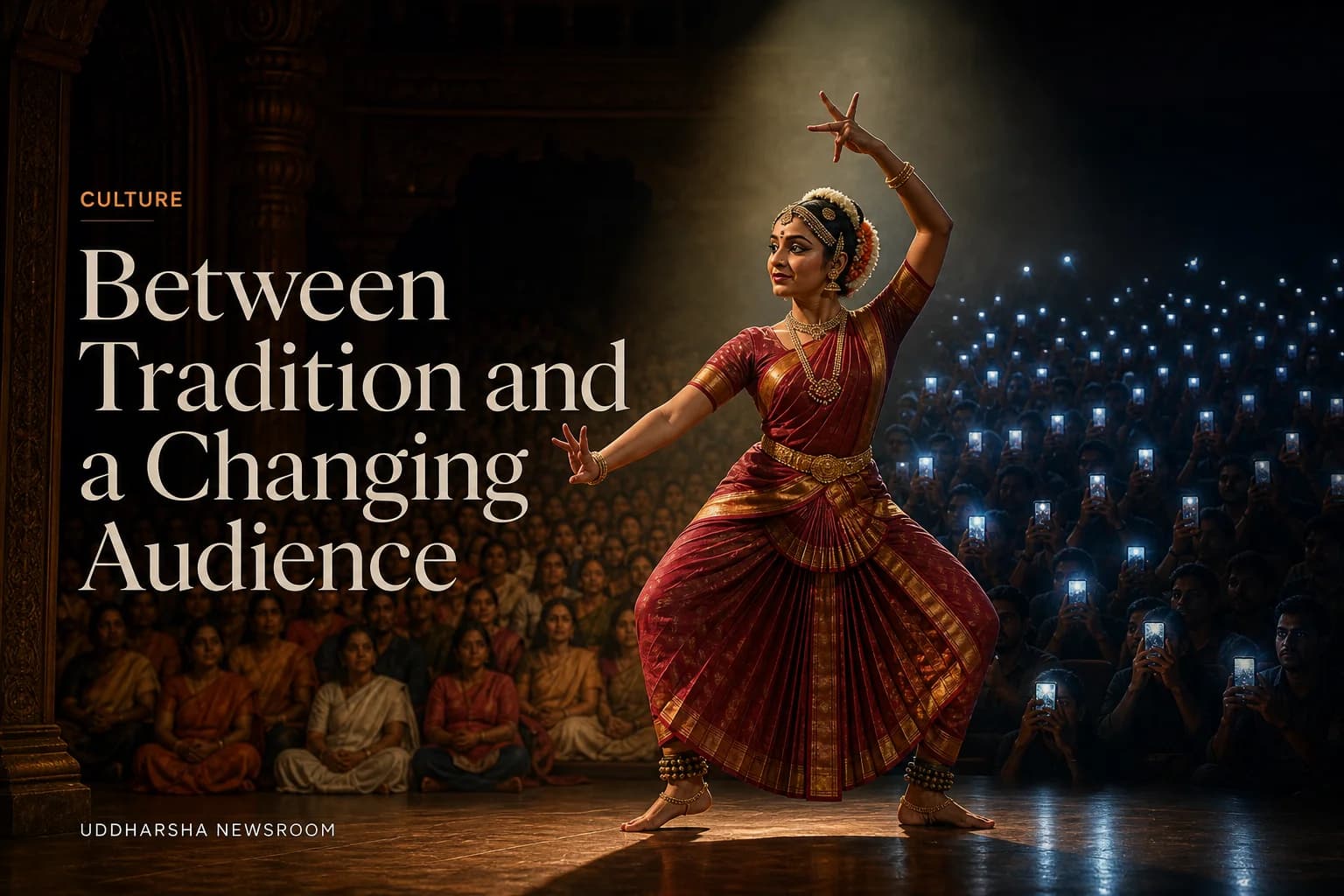
Full concert halls, 400 government scholarships and 108 new Akademi awards sit alongside a harder truth: many trained artists still struggle to build a sustainable life from decades of discipline. India's classical dance and music are not dying — they are negotiating a more demanding transition, from preservation to continuity.
Key Facts
- The Ministry of Culture's scholarship scheme provides 400 scholarships for advanced training in Hindustani and Carnatic music, Bharatanatyam, Kathak, Kuchipudi, Kathakali, Mohiniattam, Odissi, Manipuri, Sattriya and other recognised traditions
- In June 2026, the Sangeet Natak Akademi announced seven Fellows and selected 108 artists for its 2024 and 2025 awards across music, dance, theatre and traditional performing arts
- A 2025 New Delhi concert by Carnatic musicians Ranjani and Gayatri filled a 230-seat venue to overflowing, with listeners in the aisles and on parts of the stage
- Published research on careers in Hindustani classical music finds that musicians increasingly assemble livelihoods across teaching, performance and other professional work
- Digital platforms have transformed the discovery of classical music and dance, but watching remains no substitute for guru-led training and correction
- The sector's defining challenge has shifted from preservation to continuity — whether trained artists can build sustainable professional lives from the art
Indian classical dance and music are often discussed in the language of preservation. The concern usually sounds familiar: audiences are disappearing, young people are losing interest, traditional forms are being diluted, and artists are struggling to make a living. But that picture is incomplete.
Across India, classical concerts continue to draw serious audiences. Young dancers are completing years of training and taking to the stage. New students are entering established traditions. The government continues to fund scholarships, fellowships and cultural institutions. The Sangeet Natak Akademi is still recognising artists across generations and disciplines. And digital platforms have opened an unprecedented window into performances, teachers and musical traditions that were once accessible only through proximity and personal networks.
The more difficult reality is that visibility and sustainability are not the same thing. Indian classical music and dance are not facing a straightforward crisis of survival. They are confronting a more complicated transition: how to preserve depth while expanding access, how to create audiences without simplifying the art, and how to ensure that an artist who has spent decades acquiring a highly specialised skill can actually build a sustainable professional life from it.
That is where the real story lies.
The classical arts are still drawing audiences
The claim that young Indians have simply abandoned classical music is difficult to sustain. In 2025, a concert by Carnatic musicians Ranjani and Gayatri in New Delhi filled a 230-seat venue to the point that audience members occupied aisles and even parts of the stage. The performers subsequently spoke about the importance of communicating with audiences and building a relationship between the listener and the music.
The episode matters not because one full auditorium proves that classical music has become mainstream, but because it challenges the assumption that contemporary audiences have no appetite for it. They do. The question is whether that appetite can be broadened.
A classical concert does not offer the instant familiarity of popular music. A raga unfolds over time. Rhythm requires attentive listening. Much of the pleasure lies in subtle variations that may not be immediately apparent to an inexperienced listener. The same is true of classical dance. A trained eye recognises technique, abhinaya, rhythm, repertoire and lineage in ways that a first-time viewer may not.
The problem, therefore, may be less about whether people are interested and more about whether enough people are being given the opportunity to understand what they are hearing and seeing.
India continues to produce new artists
One of the strongest signs of institutional health is the existence of a continuing training pipeline. The Ministry of Culture's scholarship scheme for young artistes currently supports advanced training in Indian classical music and dance. The programme provides 400 scholarships and covers Hindustani and Carnatic music as well as Bharatanatyam, Kathak, Kuchipudi, Kathakali, Mohiniattam, Odissi, Manipuri, Sattriya and other recognised traditions.
That matters because classical traditions are transmitted through long periods of apprenticeship. The student does not simply learn a repertoire. He or she acquires a vocabulary, a discipline, a way of listening and, ideally, an understanding of the aesthetic system behind the performance. The state continues to recognise that process.
The Sangeet Natak Akademi, India's national academy for music, dance and drama, also retains a major role in recognising accomplished practitioners and sustaining the prestige of the field. In June 2026, the Akademi announced seven Fellows and selected 108 artists for its 2024 and 2025 awards across music, dance, theatre and traditional performing arts.
The institutional structure, in other words, remains intact. But a functioning training system raises another question that is harder to answer. What happens after the student has finished training?
The difficult years begin after the applause
For a young classical artist, an arangetram or a strong debut concert is a beginning, not a career. A dancer needs performance opportunities, rehearsal space, costumes, musicians, publicity and venues. A vocalist or instrumentalist needs accompanists, presenters, recording opportunities and access to audiences. Both need teaching work, touring possibilities and some degree of financial predictability.
This is where the romantic image of the classical artist begins to diverge from the economics of contemporary cultural life. A recent study of careers in Hindustani classical music published by Oxford Academic examines precisely this problem: musicians often construct careers across multiple forms of work and, in practice, move between classical and other musical or professional contexts as they build livelihoods.
That is not necessarily evidence of decline. It is evidence that the old model of patronage no longer describes the whole profession. The modern classical artist is often also a teacher, workshop facilitator, curator, collaborator, accompanist, content creator or programmer. For some, teaching is the financial foundation that allows performance to continue. For others, international students and overseas performances provide the income that domestic concert circuits cannot consistently offer.
The important point is that artistic careers increasingly have to be assembled rather than simply inherited.
Recognition is strong. Regular opportunity is less certain.
India has built an impressive architecture of cultural recognition. The Sangeet Natak Akademi awards remain one of the country's highest honours in music and dance, and the Akademi explicitly describes them as recognition not only of artistic excellence but also of sustained contribution through practice, teaching and scholarship. The Ministry's scholarship and fellowship systems provide additional routes for young and established practitioners.
Yet awards and grants answer only part of the problem. An artist does not build a career through recognition alone. A sustainable career is built through regular work.
That distinction is often lost in discussions about cultural policy. A prize may honour a senior artist. A fellowship may support a period of research. A grant may fund a production. But none of these, by themselves, creates a functioning market for artistic labour. The long-term challenge is to build a system in which artists can work repeatedly, not occasionally.
The audience problem is real, but it is not what many people think
Classical arts have long carried an image of exclusivity. The languages can be unfamiliar. Concert etiquette may feel intimidating. A two-hour recital requires patience. Classical dance sometimes assumes knowledge of mythological narratives, literary texts and the conventions of abhinaya. For older rasikas, much of this is second nature. For a first-time visitor, it can be a barrier.
That is why audience development may be one of the most important cultural tasks facing India today. The solution is not to make the art easier by stripping it of complexity. It is to make the pathway into the art easier.
A young audience member might first encounter a short performance online, then a school demonstration, then a conversation with an artist, then a carefully curated concert. The first step need not diminish the final experience. Indeed, this is one area in which the classical arts can learn from the broader cultural economy without becoming part of it.
The digital world has changed who can find classical art
The internet has altered the geography of classical culture. A student no longer has to depend entirely on living near a major cultural centre to encounter a respected performer. A listener can revisit a concert, compare interpretations, discover an unfamiliar raga or watch performances from another gharana or bani.
Dance has undergone a similar transformation. Academic work on the digitalisation of Bharatanatyam has documented the growing role of platforms such as YouTube, Instagram and Zoom in teaching, performance and audience development. At the same time, researchers have raised questions about what is gained — and what is lost — when an embodied tradition is increasingly mediated through screens.
The distinction matters. A digital video is excellent for discovery. It is not a replacement for training. A student can watch a guru's movement repeatedly. But watching is not correction. A recording can reveal a musical phrase. It cannot replace the disciplined listening and repeated practice through which that phrase becomes part of a musician's instinct.
Technology has widened the doorway. It has not eliminated the need for teachers.
Social media is changing the way classical artists introduce themselves
There is understandable unease about the rise of short-form video. A serious dancer posting a 30-second clip can attract tens of thousands of viewers who may never attend a recital. A musician can reach an audience beyond the traditional sabha circuit. A younger generation of artists can build visibility without waiting for established institutions to discover them.
That is an opportunity. But visibility can also distort artistic priorities. The conventions of social media reward immediacy, novelty and repetition. Classical music and dance often reward the opposite: patience, concentration and gradual development.
The answer is not to reject Instagram or YouTube. It is to use them intelligently. A short video should function as an invitation to go deeper, not as a substitute for depth. The best digital strategy for classical arts may therefore be one that takes the viewer from the clip to the concert, from the concert to the context, and from the context to sustained engagement.
There is an equally important debate within the dance and music communities
The classical arts are not static museum pieces, and contemporary artists are increasingly questioning how traditions should be taught and presented. That conversation can be uncomfortable.
Senior practitioners have warned against reducing a complex knowledge tradition to a collection of performance items. In a 2025 discussion on Bharatanatyam, veteran dancer Alarmel Valli raised concerns about the difference between learning a repertoire and developing a deeper understanding of the dance as a knowledge system.
This is not an argument against change. It is an argument for depth. Indian classical dance is not simply movement arranged to music. Classical music is not simply a sequence of compositions. Both are systems built over centuries, carrying literature, aesthetics, rhythm, language, interpretation and intellectual traditions. A performer who knows the choreography but not its context may be technically accomplished and still lack artistic maturity. The same applies to music.
The future will depend partly on whether institutions and teachers can provide both accessibility and depth.
Innovation is not the enemy of tradition
There is another false choice that needs to be rejected. Traditionalists sometimes fear that experimentation will dilute classical forms. Younger artists can feel that excessive conservatism leaves little space for them to speak about the present.
The reality is that every major classical tradition has changed over time. The question is not whether change should occur. The question is what survives through the change.
Contemporary productions increasingly use classical dance to address subjects beyond the traditional repertoire, including ecology, contemporary identity and new narrative forms. These experiments can bring classical technique into conversation with present-day concerns without necessarily abandoning its underlying grammar.
That tension is healthy. An art form that never changes can become ceremonial. An art form that changes without knowing what it inherited risks losing its identity. Classical artists therefore have to negotiate two responsibilities at once: to remember, and to create.
The next generation needs more than scholarships
The government can support young talent through training. Institutions can provide recognition. Gurus can provide knowledge. But none of these guarantees that a young artist will continue. The more difficult transition occurs when a student becomes an independent professional.
This is where the performing-arts ecosystem needs to become stronger. Young artists need more small and mid-sized performance circuits, not only prestigious festivals. They need opportunities to perform outside the major cultural capitals. They need affordable rehearsal spaces. They need professional support in management, production and publicity. They need audiences that are willing to buy tickets. They need presenters who understand that new artists require time to build a following.
And they need fair remuneration. An artist should not have to choose between seriousness and financial survival. Nor should artistic work be treated as something that becomes valuable only after the artist has already achieved recognition.
The smaller stage may be more important than the big festival
India understandably celebrates its major cultural festivals and prestigious auditoriums. But the health of a tradition is often determined elsewhere.
It is determined in the small dance studio where a teenager repeats an adavu for the hundredth time. It is determined in the music room where a student struggles with pitch and tala. It is determined in the modest hall where an emerging musician performs for 70 people.
It is determined by whether that dancer receives another invitation. Whether that musician is paid on time. Whether the teacher can continue teaching. Whether there is an audience next month.
These are not glamorous questions. They are the infrastructure of culture.
Classical music and dance also need better cultural journalism
There is another gap that receives surprisingly little attention: how the arts are discussed in public life.
Classical culture is often covered through announcements, event listings, award stories and profiles of established figures. Much less space is devoted to serious criticism, contextual reporting, institutional accountability, pedagogy or the economics of artistic work.
That matters. An ecosystem develops when people write about it critically. Artists need informed criticism. Audiences need context. Institutions need scrutiny. Young practitioners need to see that their work belongs to a larger public conversation.
A healthy classical-arts culture therefore requires not only performers and teachers, but writers, critics, archivists, researchers, presenters and informed audiences.
Analysis & Context
So where do Indian classical arts stand today? They are neither on the verge of extinction nor comfortably secure. They are alive, respected and evolving — but economically uneven.
India continues to produce talented musicians and dancers. Institutions continue to train and honour artists. The state continues to support scholarships, fellowships and cultural programmes. Audiences remain willing to turn out for compelling performers.
At the same time, the profession remains difficult to sustain for many artists, particularly those in the early and middle stages of their careers. The challenge is no longer simply preservation. It is continuity. Can a student become a performer? Can a performer become a professional? Can a professional remain financially viable? Can an audience member become a rasika? Can a rasika introduce the art to another generation?
Those questions are interconnected. And perhaps the most important of them is the simplest: can an artist make a dignified life from the art to which he or she has devoted decades? Until the answer is more often yes, claims of revival will remain incomplete.
The Uddharsha Perspective
Editorial interpretation — the Foundation's view, distinct from the reported facts above
The future of Indian classical dance and music will not be decided by awards alone, nor by social-media numbers, nor by the number of festivals held in a year. It will be decided by what happens between the generations.
A guru must have a student. A student must have a stage. A stage must have an audience. An audience must have curiosity. And the artist must be able to earn enough to continue.
India has already done much to preserve its classical traditions. The next task is more demanding: to build the social, educational and economic conditions in which those traditions can continue to live.
The objective should not be to freeze classical music and dance in the form in which we inherited them. It should be to ensure that they remain rigorous enough to retain their identity, open enough to speak to the present, and sustainable enough to reach another generation.
That is the real test of whether India's classical arts are thriving.
Source & Verification
Editorial analysis by the Uddharsha Editorial Desk, drawing on publicly available reports, registers and data acknowledged below.
- Original Source
- Ministry of Culture, Government of India; Press Information Bureau; Sangeet Natak Akademi; academic research and press reporting on Indian classical music and dance
- Source Publication Date
- June 2026 (Sangeet Natak Akademi Fellows & Awards announcement)
- Government & Institutional Sources
- Press Information Bureau, Government of India — Sangeet Natak Akademi Fellows and Awards announcement, June 2026 (7 Fellows; 108 artists selected for the 2024 and 2025 awards)
- Ministry of Culture, Government of India — Award of Scholarships to Young Artistes in Different Cultural Fields (400 scholarships across classical music and dance traditions)
- Ministry of Culture — Scholarship to Young Artists (SYA) Scheme 2025–26, official guidelines
- Sangeet Natak Akademi — Awards and Honours
- External Reports
- The Indian Express — arts & culture reporting on Carnatic music, Bharatanatyam and audiences
- Academic research: study of careers in Hindustani classical music (Oxford Academic); research on the digitalisation of Bharatanatyam pedagogy and performance
- Data & Statistics
- Editorial note: government scholarships, awards and institutional programmes cited here describe specific support mechanisms; they do not represent the total population or income conditions of India's classical artists. Audience examples are individual events, cited to illustrate demand — not to claim a nationwide audience trend.
All externally produced reports, statistics, photographs, videos and datasets referenced above remain the property of their original publishers and institutions. Uddharsha Foundation does not claim ownership of externally produced material; it is referenced here for reporting and public-interest analysis, with attribution.
Credits & Acknowledgements
- Written and edited by Uddharsha Editorial Desk, Uddharsha Foundation Newsroom.
- Press Information Bureau, Government of India — Sangeet Natak Akademi Fellows and Awards announcement, June 2026 (7 Fellows; 108 artists selected for the 2024 and 2025 awards)
- Ministry of Culture, Government of India — Award of Scholarships to Young Artistes in Different Cultural Fields (400 scholarships across classical music and dance traditions)
- Ministry of Culture — Scholarship to Young Artists (SYA) Scheme 2025–26, official guidelines
- Sangeet Natak Akademi — Awards and Honours
- The Indian Express — arts & culture reporting on Carnatic music, Bharatanatyam and audiences
- Academic research: study of careers in Hindustani classical music (Oxford Academic); research on the digitalisation of Bharatanatyam pedagogy and performance
- Editorial note: government scholarships, awards and institutional programmes cited here describe specific support mechanisms; they do not represent the total population or income conditions of India's classical artists. Audience examples are individual events, cited to illustrate demand — not to claim a nationwide audience trend.
Transparency note: sections presented as the Uddharsha Perspective reflect the Foundation's editorial analysis and interpretation. All other reported facts, figures and materials originate from the sources acknowledged above.
Select a topic to discover related coverage across the Uddharsha Newsroom.
Uddharsha Editorial Desk
News • Features • Perspectives
The Uddharsha Editorial Desk reports, documents and interprets developments across India's culture, heritage, tourism, education, arts, communities and wider public life.