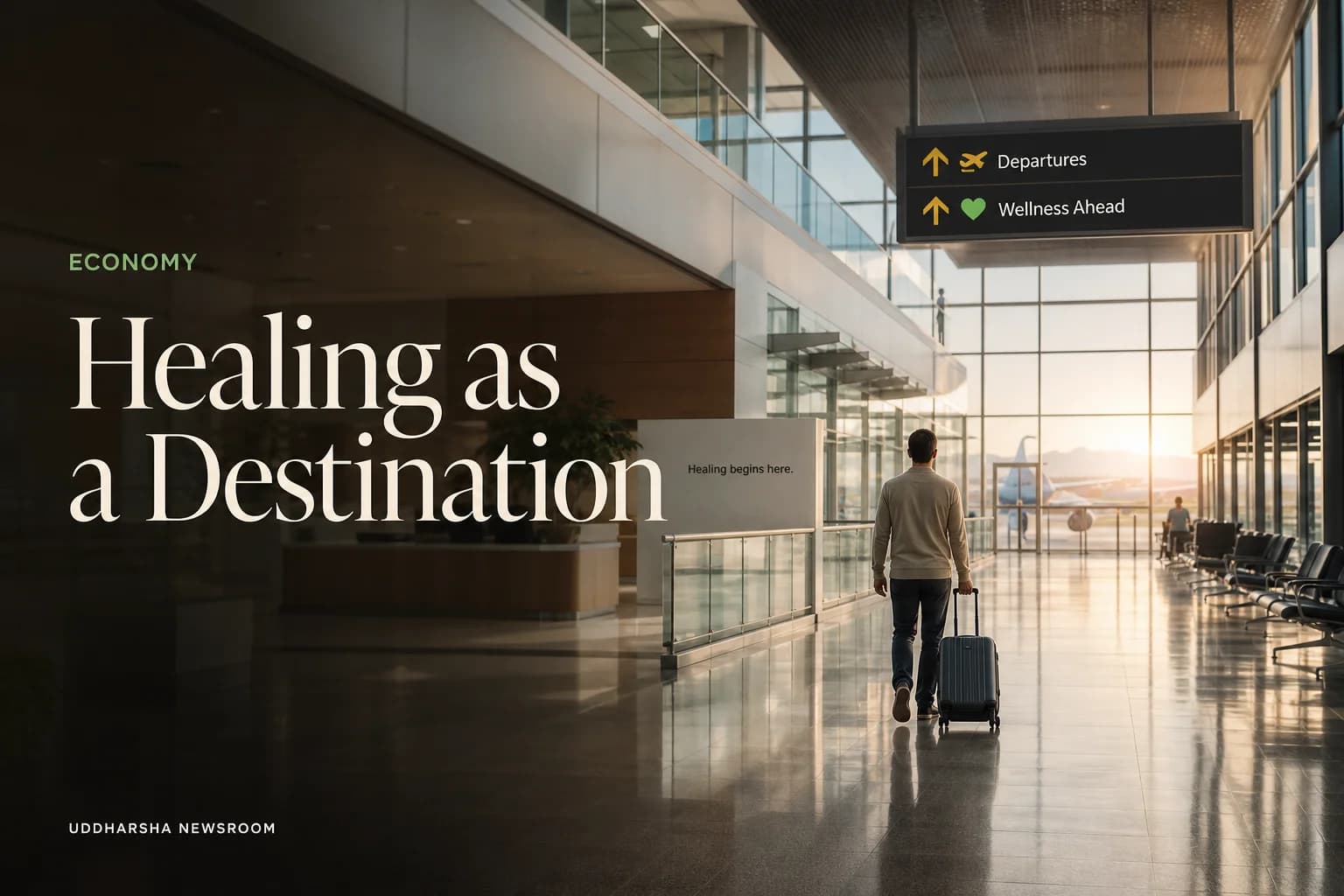
Over half a million foreign nationals travelled to India for medical treatment in 2025, in a medical value travel market now worth an estimated $8.7 billion — and projected to nearly double to $16.2 billion by 2030. A look at what is driving the rise, from world-class hospitals to the AYUSH visa, based on reporting by Livemint and Government of India data.
Key Facts
- 507,244 foreign nationals arrived in India for medical treatment in 2025
- India's medical value travel market is estimated at USD 8.7 billion in 2025
- The market is projected to nearly double to USD 16.2 billion by 2030
- Medical tourism's share of foreign arrivals rose from about 2.2% in 2009 to roughly 6.5% in 2024
- India ranks 10th among 46 destinations on the Medical Tourism Index, and 5th for wellness tourism in Asia-Pacific
- The AYUSH visa, introduced in July 2023, created a dedicated entry route for traditional-medicine treatment
Among the many reasons the world travels to India — heritage, pilgrimage, landscape, cuisine — one has quietly grown into a multi-billion-dollar economy of its own: healing. According to a recent Government of India release, reported in detail by Anjali Thakur for Livemint, India's medical value travel market is estimated at USD 8.7 billion in 2025, and is projected to nearly double to USD 16.2 billion by 2030.
The scale of the movement is striking. In 2025, 507,244 foreign nationals arrived in India specifically for medical treatment. Medical tourism's share of total foreign arrivals has climbed steadily — from around 2.2 per cent in 2009 to roughly 6.5 per cent in 2024 — making the patient-traveller one of the fastest-growing categories of visitor to the country. Globally, the medical value travel market stands at about USD 115.6 billion, and India has established itself firmly within it: ranked 10th among 46 destinations on the Medical Tourism Index, and 5th among wellness tourism destinations in the Asia-Pacific.
What draws the world here is a combination few countries can offer: internationally accredited hospitals and skilled specialists at a fraction of the cost of treatment in Western countries, English-speaking medical staff, and — increasingly — India's traditional systems of healing. This is where the story becomes more than a healthcare story. The AYUSH visa, introduced in July 2023, created a dedicated entry route for foreign nationals seeking treatment under Ayurveda, Yoga, Naturopathy, Unani, Siddha and Homeopathy, with e-AYUSH and attendant visa categories following. It is a formal recognition that India's wellness traditions — refined over millennia — are themselves a reason the world travels.
Analysis & Context
The institutional groundwork is deepening. The Union Budget 2026–27 proposes five integrated Regional Medical Hubs, combining medical care, education and research, each with dedicated AYUSH Centres and facilitation desks for international patients — to be developed with state governments and the private sector. Quality assurance runs through NABH accreditation of hospitals and the adoption of ISO standards for medical tourism services, giving international patients a trust framework that matches global norms.
The Uddharsha Perspective
Editorial interpretation — the Foundation's view, distinct from the reported facts above
For those of us working in responsible tourism, the rise of medical value travel carries a familiar lesson in an unfamiliar setting. The patient who travels for treatment rarely travels alone — family members accompany them, stays stretch into weeks, and recovery often becomes a gentler kind of journey: wellness retreats, quiet heritage towns, restorative landscapes. Each of those weeks is livelihood — for guesthouses, drivers, cooks, caregivers and local economies far beyond the hospital gate.
There is also a cultural dimension worth naming. The traveller who comes to India for Ayurveda or Yoga is engaging with living heritage in its most intimate form — knowledge systems carried by practitioners, gurukuls and communities across generations. Ensuring that this global demand strengthens authentic practice, fairly rewards its custodians, and does not reduce tradition to a spa menu is precisely the kind of challenge responsible tourism exists to answer.
The projection is clear: by 2030, India's medical tourism economy is expected to nearly double. The opportunity before the country is to grow it the right way — with quality, dignity and authenticity at the centre, so that the world does not merely get treated in India, but is genuinely cared for by it.
Source & Verification
This article is based on published reports, government data and secondary sources, reviewed and contextualised by the Uddharsha Editorial Desk. It is not original field reporting.
- Original Source
- Livemint — 'Explained: India's $8.7 billion medical tourism industry, and where it's headed by 2030' by Anjali Thakur
- Source Publication Date
- 19 August 2026
- Original Source
All externally produced reports, statistics, photographs, videos and datasets referenced above remain the property of their original publishers and institutions. Uddharsha Foundation does not claim ownership of externally produced material; it is referenced here for reporting and public-interest analysis, with attribution.
Credits & Acknowledgements
- Written and edited by Uddharsha Editorial Desk, Uddharsha Foundation Newsroom.
- Original report: 'Explained: India's $8.7 billion medical tourism industry, and where it's headed by 2030' — by Anjali Thakur, Livemint
- Primary source: Press Information Bureau (PIB), Government of India
- Statistics & data: Ministry of Tourism, Government of India
- AYUSH systems & visa framework: Ministry of AYUSH, Government of India
Transparency note: sections presented as the Uddharsha Perspective reflect the Foundation's editorial analysis and interpretation. All other reported facts, figures and materials originate from the sources acknowledged above.
Select a topic to discover related coverage across the Uddharsha Newsroom.
Uddharsha Editorial Desk
News • Features • Perspectives
The Uddharsha Editorial Desk reports, documents and interprets developments across India's culture, heritage, tourism, education, arts, communities and wider public life.