

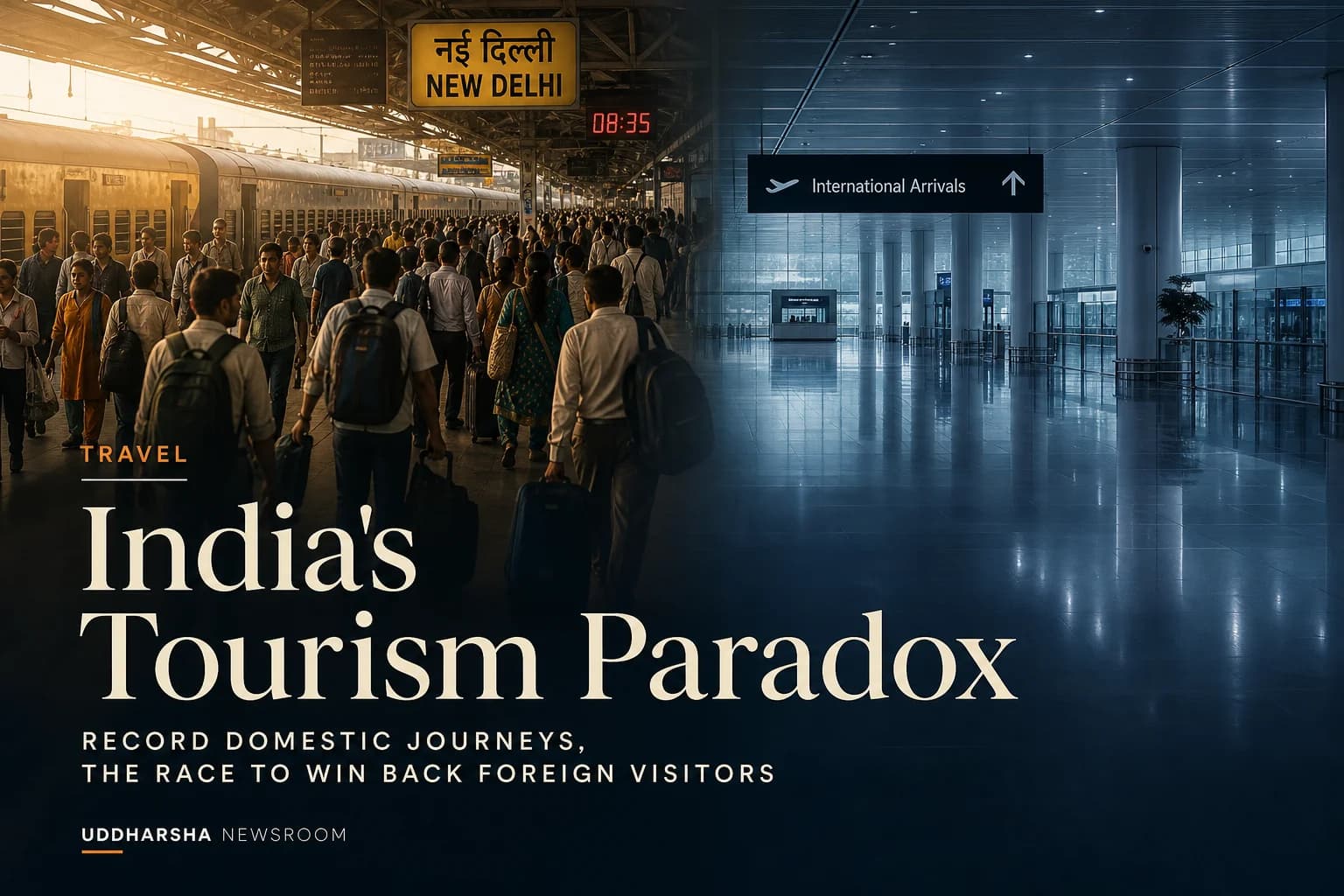
A landmark NITI Aayog report finds Indians travelling within their own country in record numbers — 2.9 billion domestic visits in a single year — even as foreign arrivals continue working their way back past pre-pandemic levels. Reforms now aim to make India's 44 UNESCO World Heritage Sites easier to reach, and easier to love.
Key Facts
- Indians made 2.9 billion domestic tourist visits in 2024 — surpassing the pre-pandemic peak of 2.3 billion in 2019
- Tourism contributed an estimated ₹15.73 lakh crore to India's GDP in 2023–24, around 5.2% of the economy
- The sector supports over 84 million direct and indirect livelihoods — roughly one in every eight jobs
- Foreign tourist arrivals stood at 9.95 million in 2024, still behind peer destinations in Southeast Asia
- India welcomed around 20.6 million total international arrivals and earned close to USD 35 billion in receipts
- India holds 44 UNESCO World Heritage Sites, 106 national parks and 18 biosphere reserves
Two very different stories sit inside the recent report 'Unlocking Growth in Tourism and Hospitality Sector', released by the Ministry of Tourism in collaboration with NITI Aayog — and together they explain both the confidence and the urgency in Indian tourism today.
The first story is a record. Indians travelled within their own country 2.9 billion times in 2024 — comfortably surpassing the pre-pandemic peak of 2.3 billion domestic visits recorded in 2019. Domestic travel has become the engine of the sector: tourism contributed an estimated ₹15.73 lakh crore to India's GDP in 2023–24, around 5.2 per cent of the economy, and supports over 84 million direct and indirect livelihoods — roughly one in every eight jobs in the country. Pilgrimage circuits, hill stations, heritage towns and coastal escapes are being rediscovered by Indian travellers at a scale the sector has never seen.
The second story is a challenge. Foreign tourist arrivals stood at 9.95 million in 2024 — still working their way back past pre-pandemic levels, and well behind peer destinations such as Thailand, Malaysia and Vietnam. Counting all international arrivals, India welcomed around 20.6 million visitors and earned close to USD 35 billion in tourism receipts. Yet India's share of global international tourist arrivals remains below 1.5 per cent — a striking gap for a civilisation with this much to show the world.
The report is unambiguous about what India holds. Forty-four UNESCO World Heritage Sites. One hundred and six national parks. Eighteen biosphere reserves. Some of the world's deepest pilgrimage, wellness and living cultural traditions. On global competitiveness indices, India ranks among the top ten nations for both natural and cultural resources. The assets, in other words, are not the problem — the experience of reaching them, staying near them and understanding them is where the gap lies.
Analysis & Context
That is precisely where the reforms now underway are aimed. The roadmap calls for streamlining approvals and licensing for hospitality investment, treating tourism infrastructure with the seriousness given to industry, and building tourist-friendly infrastructure across heritage destinations — better access, signage, amenities and interpretation at the monuments and living heritage sites travellers come to see. For international visitors, it recommends simpler visa processes and easier payment systems, removing the small frictions that quietly decide where the world chooses to travel.
The Uddharsha Perspective
Editorial interpretation — the Foundation's view, distinct from the reported facts above
For those of us working at the intersection of tourism, heritage and community, the report's two stories carry one shared lesson. The 2.9 billion domestic journeys prove that Indians want to encounter their own country — and that demand can either concentrate on a handful of overburdened destinations, or be guided toward the hundreds of craft clusters, heritage towns and cultural landscapes that need visitors most. Likewise, the foreign traveller India seeks to win back is increasingly the traveller who stays longer, spends deeper and cares about the community behind the destination.
The opportunity, then, is not simply more tourism, but better tourism: journeys that fund the upkeep of heritage rather than wearing it down, that turn visitor spending into artisan and community livelihoods, and that present India's forty-four World Heritage Sites not as backdrops for photographs but as living places with custodians, stories and futures. The report has set the direction. What India builds on it — and how responsibly — is the story still being written.
Source & Verification
This article is based on published reports, government data and secondary sources, reviewed and contextualised by the Uddharsha Editorial Desk. It is not original field reporting.
- Original Source
- Report — 'Unlocking Growth in Tourism and Hospitality Sector', Ministry of Tourism & NITI Aayog
- Source Publication Date
- 30 June 2026
- Government & Institutional Sources
- Video & Multimedia Sources
All externally produced reports, statistics, photographs, videos and datasets referenced above remain the property of their original publishers and institutions. Uddharsha Foundation does not claim ownership of externally produced material; it is referenced here for reporting and public-interest analysis, with attribution.
Credits & Acknowledgements
- Written and edited by Uddharsha Editorial Desk, Uddharsha Foundation Newsroom.
- Report: 'Unlocking Growth in Tourism and Hospitality Sector' — Ministry of Tourism, Government of India, in collaboration with NITI Aayog
- Video discussion courtesy: TimesXP (YouTube)
- Statistics & data: Ministry of Tourism, Government of India
Transparency note: sections presented as the Uddharsha Perspective reflect the Foundation's editorial analysis and interpretation. All other reported facts, figures and materials originate from the sources acknowledged above.
Select a topic to discover related coverage across the Uddharsha Newsroom.
Uddharsha Editorial Desk
News • Features • Perspectives
The Uddharsha Editorial Desk reports, documents and interprets developments across India's culture, heritage, tourism, education, arts, communities and wider public life.