

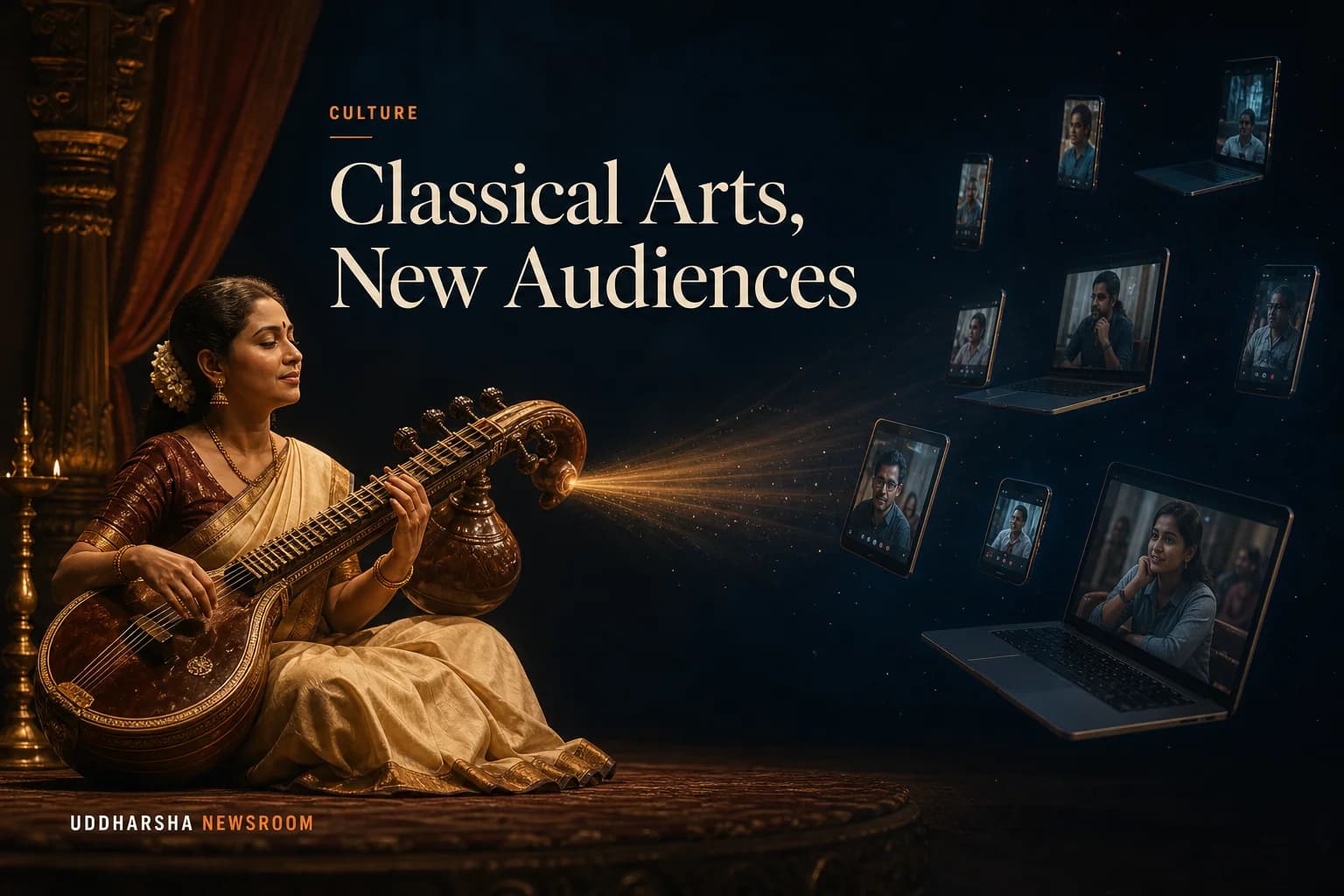
Bharatanatyam reels, streamed kutcheris, online gurukuls — India's classical performing arts are finding audiences their gurus could never have imagined. The question is what reaches the new viewer, and what gets left behind.
For most of their history, India's classical performing arts lived in intimate spaces: the temple, the court, the sabha hall, the guru's home. Their audiences were local, initiated and patient. Today a Bharatanatyam varnam can reach a viewer in São Paulo before the dancer has left the stage — and a sixty-second reel of the same performance may reach a million more.
The digital turn has been genuinely good for reach. Streaming platforms and festival channels carry full concerts across the world. Young performers build followings that would once have taken decades of touring. Diaspora families raise children on lessons taught over video calls, and online archives preserve performances by masters who are no longer living.
But practitioners of the classical arts — Bharatanatyam, Carnatic and Hindustani music, Kathak, Odissi, Kathakali and their sibling traditions — are also honest about the tension. These are long-form arts. A raga unfolds over an hour; an abhinaya sequence rewards the two-hundredth viewing. The digital formats that reach the widest audiences favour the opposite: the spectacular fragment, the highlight, the hook.
The most thoughtful artists treat the fragment as a doorway rather than a destination — using short-form content to draw new audiences toward the full experience, the live concert, the sustained study. The reel brings the viewer in; the sabha, the baithak and the gurukul do the deeper work.
What has not changed is the economics underneath. Digital fame does not automatically pay a performing artist, an accompanist or a nattuvanar. Live performance, teaching and patronage remain the financial spine of the classical arts, which means audiences, institutions and organisations that commission and host live performance still decide whether these traditions flourish.
The opportunity of this moment is real: the largest potential audience the classical arts have ever had. The responsibility is equally real — to make sure the new attention converts into livelihoods for practitioners and depth for audiences, not just views.
Source & Verification
Editorial analysis by the Uddharsha Editorial Desk, drawing on publicly available reports, registers and data acknowledged below.
- Original Source
- Uddharsha Editorial Desk — sector analysis
Credits & Acknowledgements
- Written and edited by Uddharsha Editorial Desk, Uddharsha Foundation Newsroom.
Transparency note: sections presented as the Uddharsha Perspective reflect the Foundation's editorial analysis and interpretation. All other reported facts, figures and materials originate from the sources acknowledged above.
Select a topic to discover related coverage across the Uddharsha Newsroom.
Uddharsha Editorial Desk
News • Features • Perspectives
The Uddharsha Editorial Desk reports, documents and interprets developments across India's culture, heritage, tourism, education, arts, communities and wider public life.