

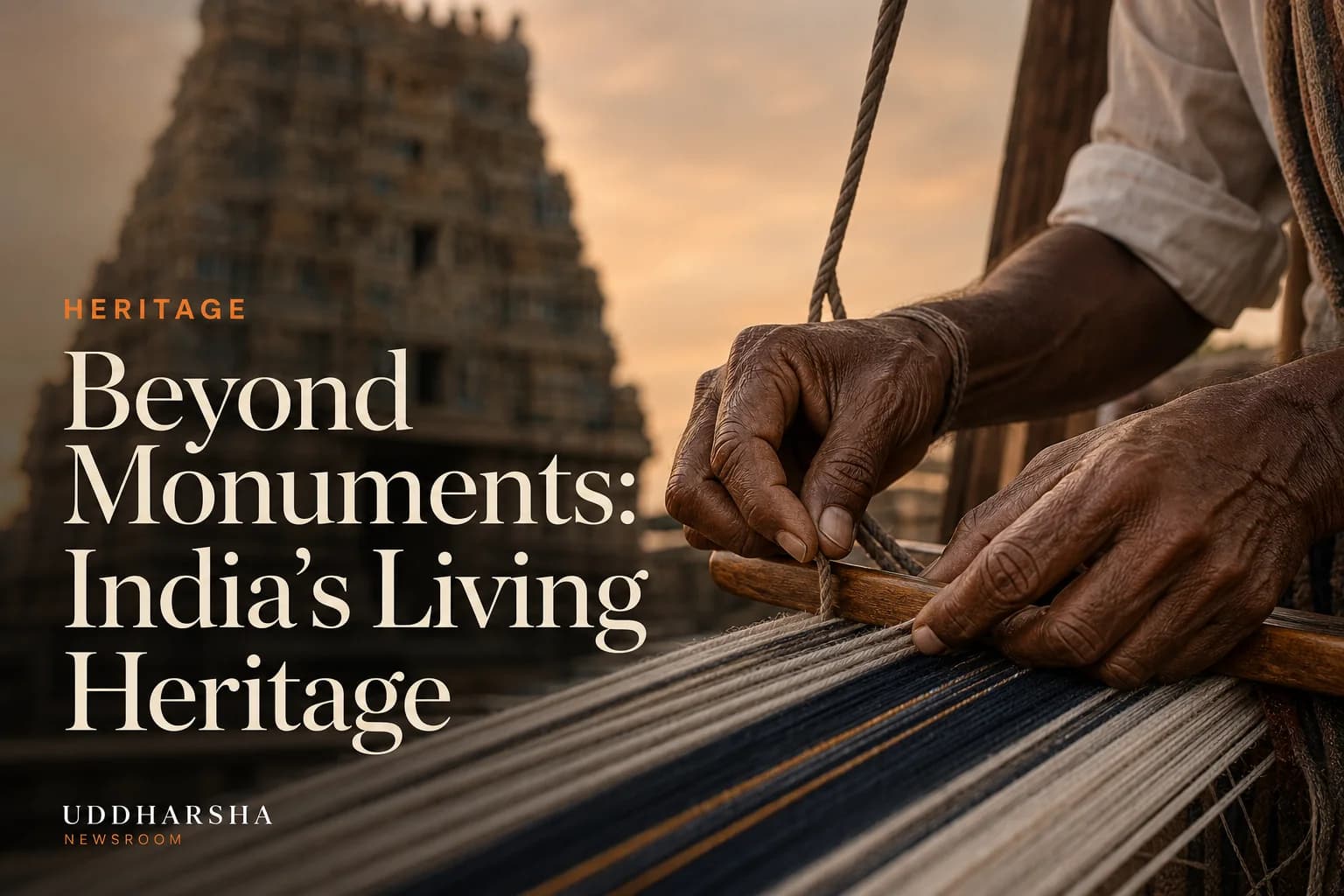
Heritage is usually pictured as forts, temples and palaces. But some of India's most fragile heritage is not built of stone at all — it lives in chants, festivals, performance traditions and the communities who practise them.
When we speak of heritage in India, the mind goes first to the monumental: the forts of Rajasthan, the temple towns of the south, the stepwells and palaces that draw travellers from across the world. But an equally significant share of India's heritage cannot be fenced, ticketed or restored with scaffolding — because it is not built of stone at all.
UNESCO calls this intangible cultural heritage: the oral traditions, performing arts, rituals, festivals and craft knowledge that live only as long as people keep practising them. India's entries on UNESCO's Representative List of the Intangible Cultural Heritage of Humanity tell that story well — from Kutiyattam Sanskrit theatre of Kerala and the tradition of Vedic chanting, to Ramlila performances, Yoga, Kumbh Mela, Kolkata's Durga Puja and the Garba of Gujarat.
What distinguishes this kind of heritage is that it cannot survive as an exhibit. A monument neglected for fifty years can still be conserved; a performance tradition neglected for one generation is gone. Its custodians are not archaeology departments but families, gurus, temple communities, village festival committees and artisan clusters — people who carry knowledge in the body and pass it on by teaching.
That is why heritage practitioners increasingly argue that conservation money and attention must follow the practitioner, not just the site. Supporting a weaver, a percussionist or a ritual performer is heritage conservation in exactly the same sense as repairing a rampart — arguably a more urgent one, since the loss is irreversible.
It is also why community-led models matter. Where communities see direct benefit — income, recognition, dignity — traditions are renewed and taught to the young. Where they see none, migration and economics quietly do what time could not do to stone.
For organisations working at the intersection of culture and livelihood, the lesson is clear: the future of India's living heritage will be decided less in museums than in homes, gurukuls, workshops and festival grounds — wherever the next generation decides the tradition is worth their life's work.
Source & Verification
Editorial analysis by the Uddharsha Editorial Desk, drawing on publicly available reports, registers and data acknowledged below.
- Original Source
- Reference — UNESCO Intangible Cultural Heritage listings
Credits & Acknowledgements
- Written and edited by Uddharsha Editorial Desk, Uddharsha Foundation Newsroom.
Transparency note: sections presented as the Uddharsha Perspective reflect the Foundation's editorial analysis and interpretation. All other reported facts, figures and materials originate from the sources acknowledged above.
Select a topic to discover related coverage across the Uddharsha Newsroom.
Uddharsha Editorial Desk
News • Features • Perspectives
The Uddharsha Editorial Desk reports, documents and interprets developments across India's culture, heritage, tourism, education, arts, communities and wider public life.